A loan payment tells you what is due this month. It does not tell you how much interest you will pay before the balance reaches zero. To see what an extra payment changes, compare two repayment schedules with the same borrowing amount, interest rate and original term.
This worked example uses the QuickToolsy loan calculator to compare no extra payment with an additional $100 toward principal each month. The amounts are hypothetical, expressed in U.S. dollars, and are not a lender quote.
The same loan, two payment plans
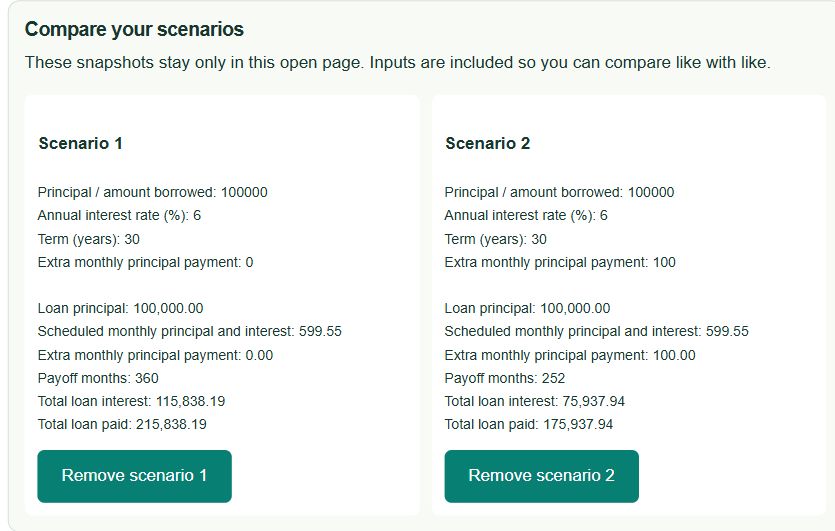
Enter a principal of $100,000, a fixed nominal annual interest rate of 6%, and a term of 30 years. First leave the extra monthly principal payment at zero. Then calculate again with an extra payment of $100.
| Measure | No extra payment | Extra $100 a month |
|---|---|---|
| Starting principal | $100,000 | $100,000 |
| Annual interest rate | 6% | 6% |
| Scheduled principal-and-interest payment | $599.55 | $599.55 |
| Usual payment including extra principal | $599.55 | $699.55 |
| Payoff months | 360 | 252 |
| Total loan interest | $115,838.19 | $75,937.94 |
| Total principal and interest paid | $215,838.19 | $175,937.94 |
In this model, the extra-payment plan finishes 108 months, or nine years, earlier. Subtracting the displayed interest totals gives $39,900.25 less interest. The final payment can be smaller than a usual monthly payment; the calculator stops once the remaining balance is paid.
Why the scheduled payment still says $599.55
The scheduled payment is calculated from the original principal, rate and term. An extra principal payment is added to that amount; it does not replace it. In the second scenario, a usual full payment is approximately $599.55 plus $100, or $699.55.
The first month’s interest in this example is $100,000 × 6% ÷ 12 = $500. Without an extra payment, about $99.55 of the scheduled payment reduces principal. With the extra $100, about $199.55 reduces principal. A smaller remaining balance means the following month’s interest is calculated on a smaller amount. Repeating that process changes both total interest and the payoff date.
Try the comparison with your own numbers
- Open the loan calculator and enter the principal, nominal annual interest rate and original term. Keep all money amounts in one currency.
- Set the extra monthly principal payment to zero, select Calculate, then select Save comparison case.
- Enter an extra amount you want to test, calculate again, and save the second comparison case.
- Compare the total interest and payoff months as well as the monthly amount. Change only one input at a time if you want to identify what caused the difference.
- Use Copy calculation or Print calculation when you want to keep the inputs with the answer. Saved comparison cases remain only in the open page and disappear when the page is refreshed.
Check the assumptions before using the result
This calculation assumes a fixed nominal annual rate, monthly payments, and an extra amount applied to principal every month from the start of the modeled schedule. It does not model a future interest-rate reset, daily-interest rules, loan fees, or penalties. Real lenders may handle payment allocation, rounding and the final payment differently.
Enter the loan’s nominal interest rate rather than a fee-inclusive APR. The Consumer Financial Protection Bureau explains the difference between interest rate and APR: APR also reflects additional loan charges. Those charges are not included in this principal-and-interest model.
If you are partway through an existing loan, entering the original principal and full term repeats the original schedule; it does not recreate your current account. A remaining-balance calculation needs the applicable remaining term and rate, and should be checked against your lender’s records. Confirm how your lender applies extra payments and whether additional charges apply before acting on an estimate.
The example shows the arithmetic of two payment plans. It does not decide which plan fits your budget or guarantee the same savings on another loan.
Compare your repayment scenarios in the free loan calculator →