QUICKTOOLSY
20% Then 10% Off, a Coupon or Buy 2 Get 1 Free: Compare the Total
A second percentage discount, a fixed coupon and a free-item offer can produce different totals even when the shelf price is identical. To compare them, keep the number of items and tax assumptions the same. This walkthrough uses the QuickToolsy discount calculator to test three fictional offers.
Every example uses three identical items priced at USD 100 each, with an illustrative 8% sales tax applied after the discount. Delivery is excluded. These are arithmetic examples, not advertised offers or a statement of the tax rules for a particular purchase.
Three offers for the same three items
- Sequential discounts: 20% off, then another 10% off the reduced price.
- Fixed coupon: USD 25 off each item, used alone.
- Bundle: buy two items and get one free, with one complete bundle.
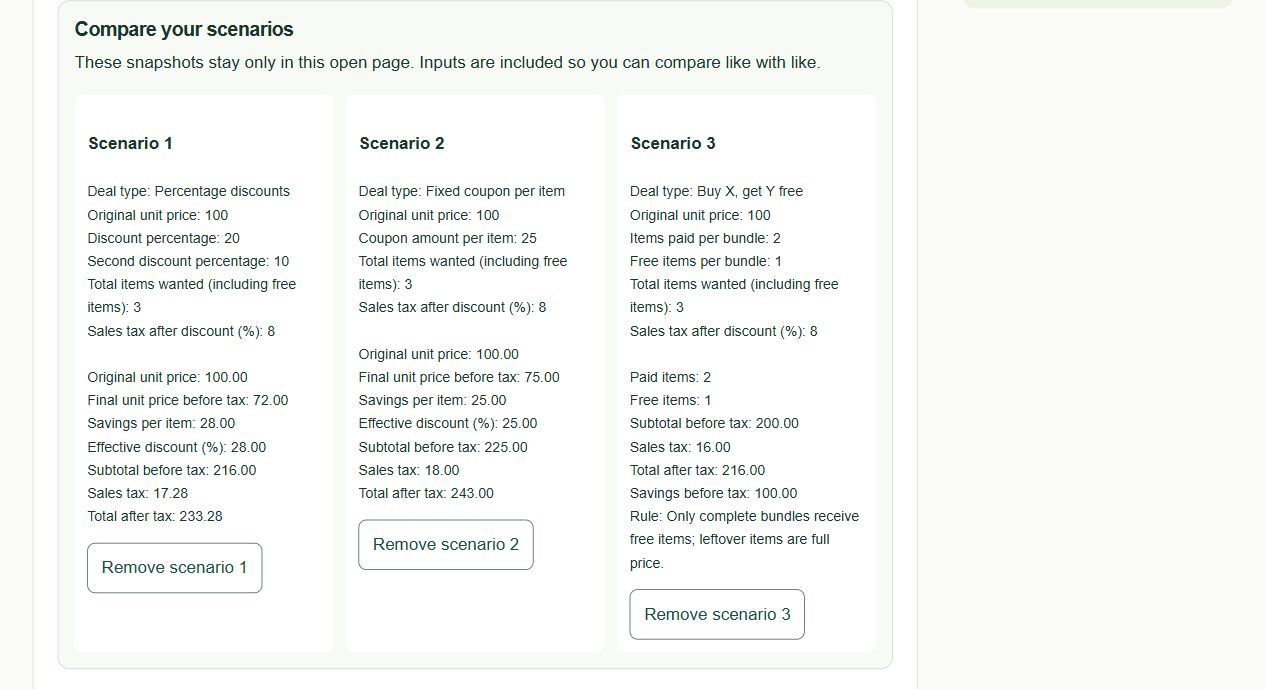
| Offer | Subtotal before tax | Example tax | Total |
|---|---|---|---|
| 20% then 10% | 216.00 | 17.28 | 233.28 |
| 25.00 coupon per item | 225.00 | 18.00 | 243.00 |
| Buy 2, get 1 free | 200.00 | 16.00 | 216.00 |
For these inputs, the bundle has the lowest total. It is 17.28 less than the sequential discounts and 27.00 less than the coupon. That conclusion depends on wanting all three identical items and qualifying for the complete bundle.
Why 20% followed by 10% saves 28%
Start with one 100.00 item. The first discount leaves 100.00 × 0.80 = 80.00. The second removes 10% of 80.00, which is 8.00, leaving 72.00. The saving is 28.00, or 28% of the original price.
For three items, 72.00 × 3 = 216.00. Adding 216.00 × 8% = 17.28 gives 233.28. Adding the two discount percentages would incorrectly treat the second reduction as 10.00 per item.
A coupon amount needs a scope
In this calculator’s Fixed coupon per item mode, a 25.00 coupon reduces each 100.00 item to 75.00. Three items therefore cost 225.00 before tax and 243.00 after the illustrative tax.
A single 25.00 coupon for the entire basket would be a different offer. Do not enter a basket coupon as a per-item coupon. Also check whether a retailer permits coupons to stack with percentage discounts. The three offers here are separate alternatives; the coupon is not applied on top of the 20% and 10% reductions.
A free item requires a complete bundle
For three items in a buy-two-get-one-free offer, you pay for two: 2 × 100.00 = 200.00. Example tax is 16.00, bringing the total to 216.00. In the bundle mode, Total items wanted (including free items) means all items you take home, so enter 3, not 2.
We also checked four items. The calculator charged for three and gave one free: subtotal 300.00, tax 24.00 and total 324.00. Only complete bundles receive free items; leftovers are full price. The offer does not become a uniform one-third discount on every quantity. Mixed-price bundles, cheapest-item-free rules and retailer-specific exclusions need a different calculation.
Try the comparison with your own prices
- Open the discount calculator and go to Compare a shopping deal, below the original percentage calculator.
- Choose Percentage discounts. Enter the original unit price, both percentage reductions, total items wanted and sales tax after discount. Select Calculate deal, then Save comparison case.
- Choose Fixed coupon per item, enter the coupon amount and calculate again. Check that price, quantity and tax still match your first case, then save the comparison.
- Choose Buy X, get Y free. Enter the paid and free counts for one bundle, then the total number of items wanted. Calculate and save the third case.
- Compare final totals as well as savings. Use Copy calculation or Print calculation to keep the current inputs with their result. Recalculate after changing any input.
Saved comparison cases remain only in the open page and disappear on refresh. Use one currency throughout. The calculator applies the entered tax rate after discounts and excludes delivery; check actual checkout terms, tax treatment and rounding before relying on a total. Buying extra items just to unlock a bundle can increase your spending even when the effective unit price is lower.